- Views: 142
Dr. Salvatore Aricò
Chief Executive Officer of the International Science Council
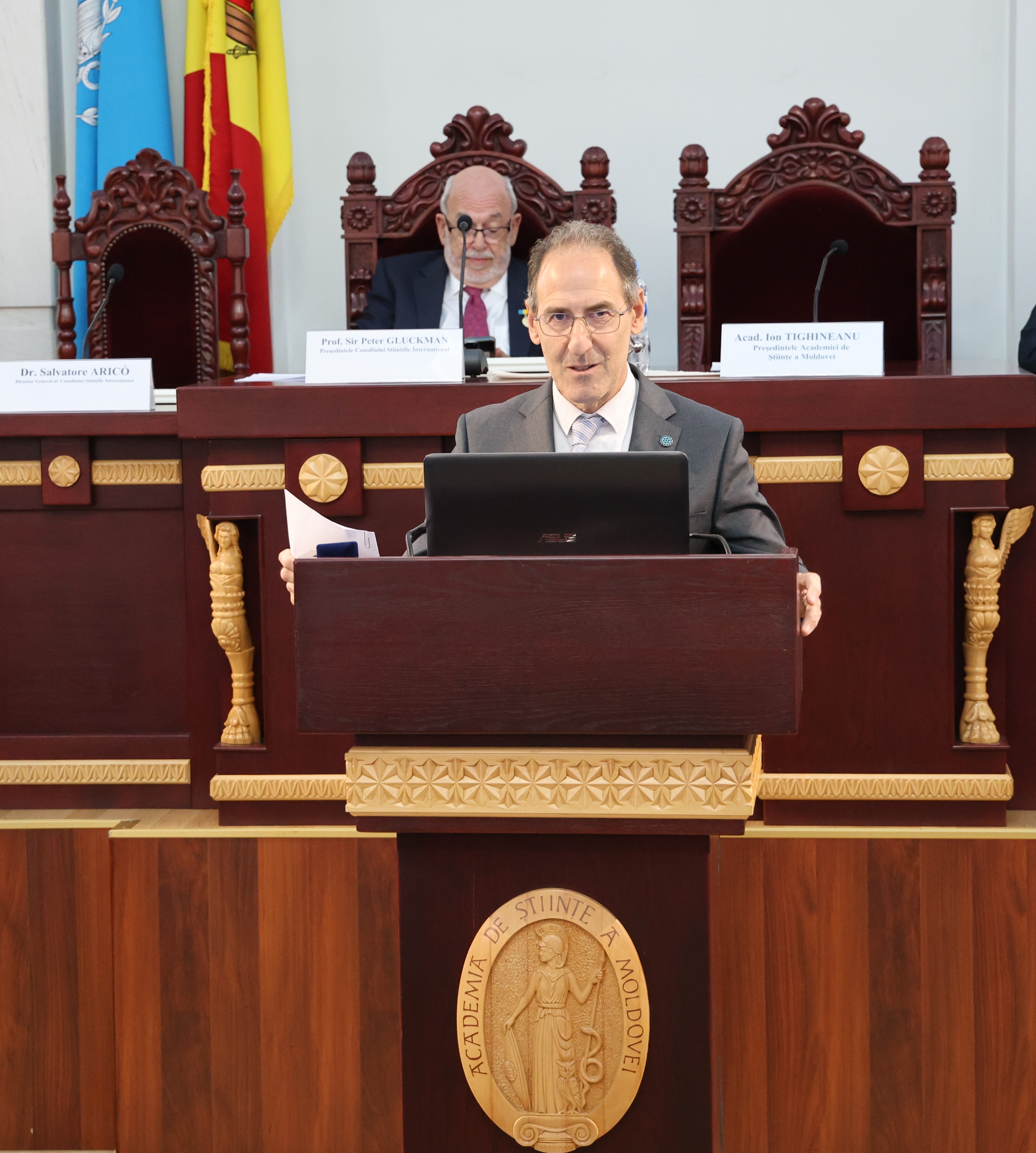
Address to the Academy of Sciences of Moldova on receiving the award of the Nicolae Milescu Spătarul Medal.
16 April 2026
Dignitaries, Distinguished Guests, Ladies and Gentlemen,
At the outset may I acknowledge how pleased I am to accept this invitation by the Academy of Sciences of Moldova and, therein, Professor Ion Tighineanu for his kindest invitation.
Moreover, I am profoundly honored to be chosen as the recipient of the “Nicolae Milescu Spătarul” Medal. I certainly do not speak 9 languages as he did but had the pleasure to understand some of the Romanian language yesterday, a pleasant discovery. But like Nicolae Milescu Spătarul I have had the opportunity in my 33 years of scientific career at the international level to develop a ‘road journal’ of how science unfolds around the world, from a practitioner standpoint.
Presenting the work of the International Science Council is not easy for the simple reason that it is a complex, reach and diverse organization.
Its mission is to speak as the global voice for science, but this can only happen if the Council is able to listen to the voice of its members in the first place. These days, the Council is ‘victim of its own success’, its membership continues to grow, we are closer to 300 members, most of which include members in good standing; others are trying to sort out some of the difficult situations with which science systems are confronted domestically, including underfunding, and yet other members are prospective members that want to join the Council, but perhaps do not yet benefit from properly organized academies of science, academies or associations of young scientists, research agencies, and other science infrastructures. The International Science Council is there to accompany them.
The vision of the Council is that of science for the global public good. As Sir Peter has explained, science is part and parcel of society, sometimes scientific discoveries have adverse uses, other times science is capable of providing solutions to shared problems; but the important thing is that science is at the table and remains trustworthy and faithful to its principles. At the same time, the Council has evolved and, nowadays, we are the largest non-governmental international organization where difficult science matters can be discussed, spanning from sustainability to science and security, science diplomacy, and in fact, many organizations and governments come to the Council precisely to host those difficult discussions.
Issues related to
-freedom and responsibility in science;
-recalling that science is a right for everyone, as stipulated in the Human Rights Declaration;
-accompanying the evolution of science systems in terms of how the performance of scientific researchers is assessed, research funding is disbursed, the science agenda is organized;
-what are the conditions conducive for science that need to be put in place by governments.
In this regard the International Science Council works closely with UNESCO and other organizations in ensuring that scientists and science systems can continue to thrive.
The Council has worked significantly on questions related to science in terms of crisis, how to protect data repositories in times of conflicts through the mirroring of those repository and other similar solutions, promoting access for refugee scholars to bibliographic and other resources. The Council has a strong and growing portfolio in the area of artificial intelligence and research integrity. It is very interesting to see how diverse experiences related to AI are taking place around the world and how different countries, including small countries with less resources in science infrastructures and funding for science are dealing with AI. The Council’s members’ actions in the area of AI span from training to legal frameworks, technical solutions to quality assurance/quality control of AI data, developing requirements for fully AI-ready data, assessing the dimensions of impact of emergency technologies beforehand rather than running after the train once those technologies have unfolded. It is an important that we capture these experiences, views and aspirations around the world – the future of science and technology is not only in the hands of those that have the resources as I speak, and in fact many of the Global North countries that lead in science sincerely see the value of scientific collaboration. ‘Science cannot remain at the edge of public life’, as President Tighineanu stated at our round table this morning on a dialogue for the future for science in a changing world.
Coordinating the research agenda when it comes to the global climate system, the global ocean, the fate of pollutants and related impact, space research, Antarctica research, research on new economic and other social sciences approaches that go beyond the GDP, understanding inequality – all these efforts within the ISC are effectively coordinated through a family of 15 research and monitoring platforms, the work of which is utilized daily in decision-making on global issues, such as the IPCC scenarios and the conference of the parties of the Framework Convention on Climate Change and its Paris Agreement.
Empowering early mid-career researchers is also a key effort of the Council through workshops to travel bursaries, the development of training modules, and dedicated podcast series. These early mid-career researchers are not mere recipients of ISC’s support, the Council provide them with a voice as well, and we are striving and rather succeeding in having early mid-career researchers represented in virtually every expert committee of the ISC as well.
The Council has a special role in the sustainable development and the post-2030 agenda. We are invited to review independently the Global Sustainable Development Report. We have done it in 2017 to 2023 and we will do it again in 2027. This means that through the ISC, the Council Members have a voice also when it comes to defining the sustainable development agenda in the years to come. The way we work is that we mobilize expertise from within the membership, undertake science campaigns, develop deliverables in a language that is accessible by policy, and also communicate with the public at large. If we are able to show that science contributes to society, then in turn policymakers, politicians, the general public, decision-makers will believe and invest in science. The Council works with the international consortia of universities, with foundations that support sciences, with governments, with UN organizations, with all science-related stakeholders, as science is more than research. Science must speak with one voice. But the only way that the Council can do so on behalf of science is to be inclusive and able to capture the diversity of the aspirations, efforts and views by its members. This means, as far as this region, having the opportunity and being able to understand the preoccupations and aspirations of the Academy of Sciences Moldova, the Academy of Sciences of Romania, and other academies and scientists in the region.
To conclude, the ISC under the presidency of Sir Peter, while remaining a membership organization, also has opened up its door to a cohort of Fellows, which by now counts around 250 Fellows, of which Academy President Tighineanu is one. There is a call that has been opened for the next cohort, and the idea is that those Fellows would be able to act as advocates on a mission of the ISC, to help the Council capture in a bottom-up way the specificities of science in multiple regions of the world, at multiple scales, and collectively to support to the Council with statements and other actions that reflect the engagement of ISC Fellows in the strengthening the overall science efforts.
Once again, many thanks for the opportunity, and I wish the Academy of Sciences of Moldova and that of Romania, and all of you great success in the years to come. The International Science Council is your house, so please do rely on us to pursue your important work.
Thank you.