- Views: 174
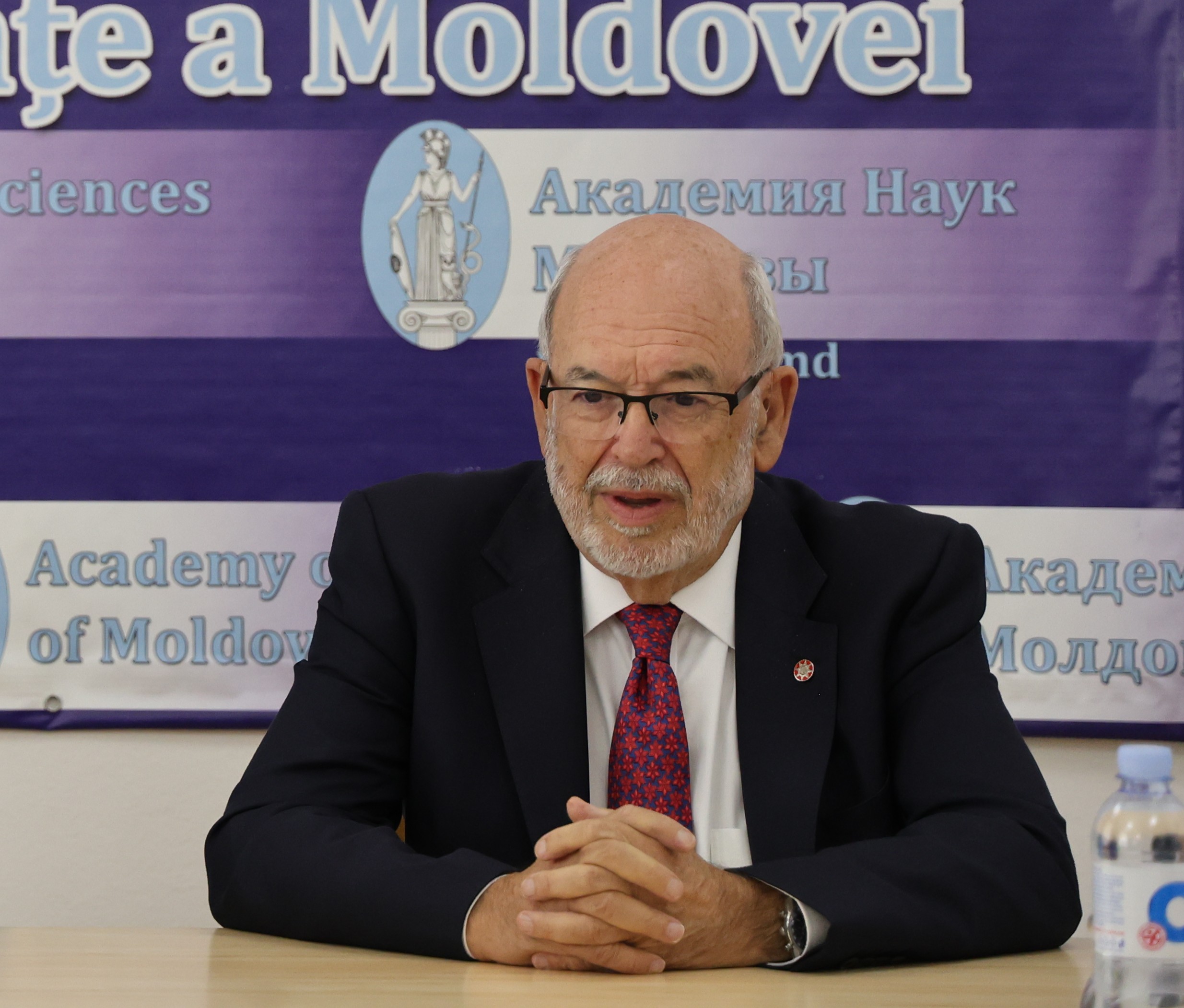
Sir Peter Gluckman
President, International Science Council
Director, Koi Tū – Centre for Informed Futures, Auckland, New Zealand
Address to the Academy of Sciences of Moldova on receiving the award of the Dimitrie Cantemir Medal.
16 April 2026
I thank the Academy for the honour of the Dimitrie Cantemir Medal. Cantemir was a politician, diplomat, scholar and scientist in another period of geopolitical disruption and change and my address today is against the backdrop of geopolitical disruption and technological change. Let me acknowledge Professor Ion Tiginyanu for his strong advocacy for science and for his support and Academy for their commitment to the work that the ISC undertakes in promoting the global voice of science. As we will discuss in my presentation there are real challenges in doing so and Dr. Arico, the CEO, will later touch on how the ISC is evolving to address these.
When I use the word science, I am referring to modern science encompassing the natural, social and technological sciences. We all recognise that rapid and massive changes are affecting science production, its reporting and its use. Some of the change has promise, some is challenging and some is disruptive. On the positive side we have seen the great diversification of those who are contributing to new knowledge; more women, more from the global south and a greater willingness of young scientists to step outside disciplinary silos and engage in transdisciplinary science.
But at the same time there are real challenges to the scientific enterprise itself.
The growth of the scientific enterprise has been associated with a raft of worrisome publishing practices. Costs, predatory journals and the impact of bibliometrics on the culture of science are most obvious. While AI can advance science it has enormously advanced fraud and bad science. Major publishers are being overwhelmed by very suspect submissions. Peer review is in trouble and the incentives created by bibliometrics are unhealthy for science as a whole and especially for young scientists. While the issues are clear, there are many reasons, often lying within our own culture and the institutions of science funding, academia and scientific egos that inhibit addressing these issues.
Trust in the production of science by scientists and the reporting of science in publications are intimately linked. As a result, the ISC and the science publishing sector are in conversation to find a robust mechanism to validate journals and their processes. There are other issues in scientific publishing but the most urgent is to address the trustworthiness of the scientific record as trust in sciences o trust in the academic record.
The distinguished scholar of science, Dan Sarawitz pointed out that progress in science is largely driven by progress in technologies. His argument was controversial at the time, but the emergence of AI is changing science in many ways. It is impacting on what questions are being asked, how data is collected and analysed and indeed reported. In some domains the role of traditional scientific approaches is disappearing. The impact of Alphafold on crystallography, protein chemistry and pharmacology has been profound over a very short time. Many other areas of science including social sciences will be irreversibly changed by AI. This has enormous implications for the whole scientific enterprise – from the training of scientists to the organisation and funding of science.
Computing power is becoming central to what science can be done and by whom, Increasingly the compute power needed is located in the private sector within a small group of countries: the inequalities in science capabilities between nations may again grow as a result.
The growth of basic science within the private sector has been significant over the last three decades, raising questions about the nature of science that will be done within the public sector and released as a global public good. For small countries like New Zealand where I live, full technological sovereignty is no longer possible, limiting what science can be done entirely within a country and thus shaping the importance of transnational scientific partnerships and collaborations are needed across borders.
And here we see a real challenge for the public-facing science community. Science, technology, economic power, security and geopolitical considerations are more tightly linked than ever. Science has always had patronage and for much of the last 100 years that patronage has been largely from governments and often dominated by defence and security interests. Sadly, close to here there is a prolonged and deadly war underway dominated by AI, drones and other science-based technologies. As a result, academic centres can become targets of war.
That tight linkage is changing how governments exert their patronage over science. Through their economic lens they are shifting the balance of science away from knowledge generation to downstream utilitarian exploitation reflecting the broad economic malaise many governments in the developed world face. Science must of course meet the expectations of the governments who fund science, but it is critical to the interests of citizens over the longer term, that open enquiry is sustained and that upstream science is not sacrificed for a short-term, exploitative approach.
Related to this is perhaps a shift from the relative openness that science enjoyed prior to the last decade into a more closed situation where the concept of dual use knowledge has extended from narrow security related definitions to economic considerations. Recent ministerial meetings in Europe and OECD both used the mantra ‘as open as possible, as closed as necessary” to describe science, but given the range of dual use possibilities, this can be an over-used dogma. We already see the impacts of this mindset on scientific mobility and exchange. Sadly, it is understandable in the current geopolitical context.
One of the issues that has become difficult if not impossible to address has been the ethical regulation of new technologies such as AI. These technologies do not stay bound within a single jurisdiction and are largely emerging from large and powerful companies. These non-State actors have varying degrees of integration with State interests depending on where they are based, but in the case of AI they have been impervious to effective ethical regulation controlling their use either globally or regionally. Individual nations outside the superpowers are very limited in what they can do. The ISC took a lead in trying to bridge between high level principles and effective specific uses, but the reality is that we have seen the emergence of very distinctive technopoles – USA, Europe and China with very different approaches and attitudes -yet AI is a fundamental technology likely to have enormous impact on the human condition.
This is but one of the many urgent issues facing the global commons – climate change and biodiversity loss may be the most obvious but the use of inner space, the management of the oceans, water and food security, informal and forced migration, autonomous weapons, and the management of new technologies such as AI and synthetic biology all require global cooperation.
The multilateral system is not in good health. It is generally accepted that the post-World War 2 frameworks establishing the UN and the Bretton Woods systems need revision but there is a limited willingness to find solutions. We must continue to use what is there to advance the global public good; indeed, some technical parts of the multilateral system continue to function well –the ITU and WIPO are good examples. That is why the ISC has invested to work both with the UN headquarters in New York and with its myriad of agencies to show where science can assist in their negotiations and decision making.
And this brings up the broader issue of how science impacts on decision making both within a country and beyond. I was founder president of the International Network for Government Science Advice, part of the ISC family. It has worked hard to strengthen the capacity for science to impact on domestic policy making on every continent. Academies have an important role to play especially in ensuring that the needed synthesis of evidence from pluralistic disciplines, itself a major task given the explosion of knowledge, made more convenient but also more challenging by the use of large language models.
But the synthesis of evidence alone is not enough. It requires the skills of brokerage about which I have written a lot. This requires skilled interlocuters who can communicate the need for science from the policy maker to the scientist and the knowledge to the policymaker in an unbiassed and pluralistic but understandable way. In no society does science alone make policy decisions and scientists must acknowledge that when science is needed by the policy maker, the knowledge is often incomplete, uncertainties must be communicated and their implications of different options that arise considered.
But at the multilateral level it is more complicated. Diplomats’ roles are to advance their nation’s interests by negotiation. But often they need science – whether it is in trade negotiations or disputes or over resource management across shared boundaries. They may not even recognise when science can help. But, when it comes to issues of the global commons, tensions between the ideal and reality become apparent. We have seen in the case of climate change how national interests easily out way common interests. And here is a key role for science diplomacy. Scientists must work with their own governments to show how it is in their long-term national interest to address issues of the global commons. These are not easy arguments as there is always a political bias to the short term at the expense of the longer-term.
But we should not give up. The Antarctic treaty of 1959 has stood the test of time; the Montreal protocol is another example where science achieved progress on the global commons even in the presence of superpower tensions. Many of the ISC’s affiliate bodies work to coordinate science on the global commons. But the real battle remains to embed science-based foresight within domestic politics.
To now I have skirted around two big elephants in the room: the geopolitical state of the world and trust in science. I need to spend time on each.
The enthusiasm that accompanied the end of the cold war and the push towards a global perspective met its peak a decade ago when in 2015 the Sustainable Development Goals were launched, the Paris Accord was reached and international cooperation on disaster risk reduction was reinforced by the Sendai agreement. The SDGs had many flaws – while they applied to every country, how they were implemented was subject to each country’s own deliberations and targets and in many developed countries were given tokenistic attention. They were complex, not striking a meaningful balance between those goals that tried to limit resource extraction and those that focused on components of human wellbeing dependent on energy and resource extraction. Progress on virtually all the goals is poor and the midterm 2024 UN summit of the futures and its companion declaration on future generations has had virtually no visibility or impact.
As we approach 2030, we do so in a very different world to 2015. One in which nationalism and autocracy are resurgent, brutal conflict continues unabated. It is a world where compute power, energy supplies and critical mineral access sit alongside food and water insecurity and the growing impacts of climate change and informal migration as considerations in virtually every society.
While geopolitical contestation is now greater, the impacts on the global commons are becoming very apparent. The science community acting collectively needs to try and shape how the SDGs might be effectively transformed to effect. But this requires both natural and social scientists to work alongside diplomats to find a pathway forward. By way of illustration, I point to the work of the ISC in partnership with UNEP identifying the challenges we must address if a healthy environment is to be achieved. It is the better use of science-informed foresight informing citizens and politicians within every country that will be essential if progress is to be made on the global commons.
The other elephant in the room is the issues of trust, populism, polarisation and the positioning of science within society
The emergence of a very different nature of public discourse in the last two decades was accelerated by the development of social media. While there has always been misinformation and disinformation, social media allowed it to spread at pace not possible before. This combination of a change in public discourse and the ability to disinform has fuelled polarization within societies, effectively shifting the debates amongst citizens from policy and ideology to personality and affect. Interested parties can fuel disinformation in ways they could not before. In this more emotionally changed environment, rational democratic processes lose to extremist views, fear and anger.
At the same time as social and economic inequalities have grown in developed countries, anger further fuelled by extreme excesses especially by elites. Migration fears add challenging citizens’ identity. All this puts democracy at risk. There are challenges here for science. As trust in institutions in general falls, the institution of science can be compromised.
A major thrust of the ISC’s current work programme to is to address this issue of trust in science. We need insights from social psychology, political science, philosophy and economics. A challenge which my own centre in New Zealand focuses on is how to sustain social cohesion in this very different environment.
The issue of trusting science is complex – I traversed briefly the issues of producing trustworthy science through a commitment to responsibilities in the conduct of the science, those in the reporting of science, and the question of whether science has been caught in the more generalised loss of trust in institutions at least in the so-called liberal democracies.
But there are other components. Science communication is still too often in the Mertonian mode – Robert Merton, the sociologist of science, described scientists preaching from the alter, supposed truths to an ignorant congregation. That framing should be outdated, but too much science communication still assumes a deficit model. It ignores the reality that it is how science is used which can have a high values component which must be evaluated by society and scientists alone cannot address.
In this very different information environment, more attention needs to be paid to how science is communicated. We need to get beyond the hyperbole that too often accompanies scientists in the media, and become much better at recognizing that the use of much science depends on its intersection with values which may be in dispute. Science funding bodies need to be realistic in what they expect when they demand impact from research. It is very seldom that an individual piece of work will change anything – science is a process of knowledge building on knowledge until new understandings lead to new ways of doing things, innovations and new understandings often in areas well removed from where the research started. This is one of the real dangers in the utilitarian shift in science funding occurring in many countries
A key issue for science is communicating uncertainty. Much science communication including to policy makers has hidden the reality that much knowledge is provisional and that there are inherent uncertainties in much of what we conclude – the inferential gap that the philosopher of science, Heather Douglas has written much about.
In the end science produces knowledge – it is how the knowledge is used that can generate distrust. Science produces inconvenient truths. Special interests like those benefitting from fossil fuel production, inevitably will fight back against progress on climate change. We are now seeing the same with regards social media. Despite the evidence that it can do harm, especially harm to the mental health of young people and in spread antisocial disinformation, social media companies have shown an enormous capacity to resist.
New technologies now emerge rapidly without social licence – look at the debate in Europe that accompanied the emergence of genetic modification of crops - a debate that has an echo 30 years later and is still limiting how genomic science can be used to advance food security. In some countries issues are emerging about the use of big data without considering the social implications and controls that are needed – yet big data will allow policy makers to make better choices in many areas to improve social services.
Many of these issues converged in the Covid pandemic. We saw scientists avoiding communicating uncertainty, not explaining the provisional nature of science for example over mask wearing, we saw politicians misusing science when claiming “ we are just following the science” when other political agendas were in play, we saw the promotion of disinformation about vaccines, we saw a lack of international cooperation restricting access to vaccines even to countries that provided core genomic data and so forth. And echoes remain. There has been a loss of trust in a key multilateral agency; debates over the source of Covid continue. Antivaccination has become a hallmark of political movements and a fuel for conspiracy theory. 20 years of science that led to the amazing development of the mRNA vaccines is now compromised by disinformation and fearmongering.
This is not how science, technology, business, society and governments should interact in an ideal world and particularly in the face of a crisis. The ISC spent much effort working with UN agencies to explore the issues arising from the pandemic with two important reports for governments– we need to learn from this episode to ensure that science can play its proper role in helping society at every level from local to global.
I have hinted throughout this address that the science community needs to be more self-reflective if we are to contribute optimally to a better future. The technologies that science helped create are changing the trajectory of our development. This is not new – agriculture changed the biosphere, energy technologies are the primary reason for global warming, information technologies are changing who we are and how we related to each other. The history of our species is as social animals. The question is now - how will we cope with the pace of cultural evolution we have unleashed?
Science has a critical role to play. It starts with cleaning up our own act, less hyperbole, eliminating untrustworthy behaviours, eliminating the deluge of poor science or even fraudulent science in poor journals, focusing on science communication in more effective ways. Scientists need to be trained differently – most scientists have no formal training in ethics, in the philosophy of science, on science-society interactions, on the science policy interface. I believe topics such as these should be essential in the training of every natural or social scientist. We need to work with our communities, explain the scientific method, remove the mystery without patronising simplification. Science education in schools in most countries is poor or out of date. Science and technology will determine our future - the next generation deserve to understand how and how it should be used or not.
Academies must take a lead in working with their governments – addressing issues in science education both at schools and universities, enhancing the science policy and science diplomacy interfaces and ensuring that policies for science are appropriate for the realities of the scientific method and the needs of society.
Dimitrie Cantemir was a polyglot. He spoke and wrote in eleven languages. And so, I would like to finish with a reflection on language.
Language allows us to communicate. Humans have evolved with a sophistication of language allowing us to learn from each other, to cooperate and negotiate and build the complexity of our societies. But languages can also divide, identifying who is in an in-group and who is not as the history of Europe can remind us.
But ultimately language unites groups and in these difficult times we need a universal language. And perhaps we have one. It is called science. While its formal definition may be difficult, modern science has pancultural underpinnings and is the nearest we have to a universal language. Can we use this commonality to take our knowledge and forge a future which advances planetary, biotic, social and human wellbeing. It is not easy in the current context and may never be easy, given our human and institutional natures. But if we accept that science cannot answer everything or make societal decisions on its own, but share scientific understandings we can again regain optimism for the future that we seem to have lost.
I thank you and thank the Academy.